



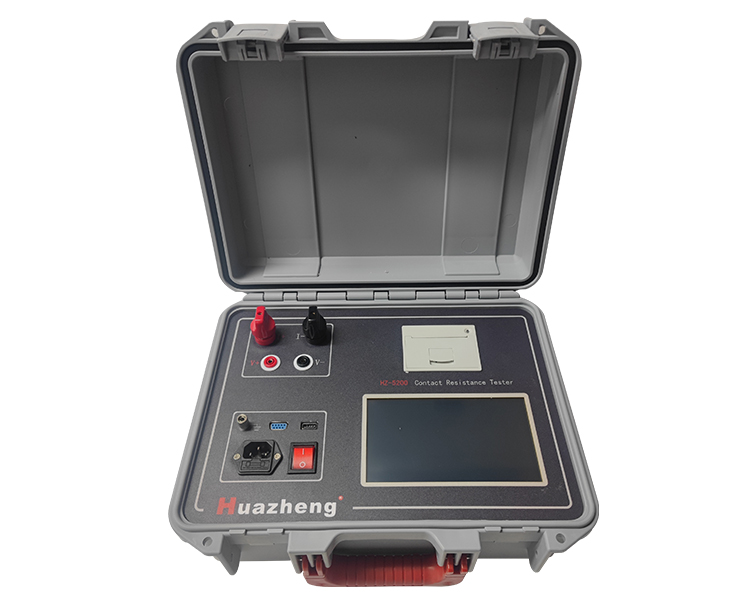
In high-voltage environments—substations, switchyards, circuit breaker installations—the integrity of electrical connections isn’t just a maintenance concern; it’s a safety imperative. Loop resistance testers, often overlooked in favor of flashier diagnostic gear, serve as the quiet guardians of conduction reliability. Their primary role? Quantifying the resistance across bolted or welded joints in conductive paths, where even marginal increases can signal incipient failure. Unlike insulation testers that probe dielectric strength, these instruments focus on metallic continuity under load-like conditions, typically using DC current injection to mimic real-world operational stress.
Transmission and distribution utilities rely heavily on loop resistance measurements during commissioning and periodic maintenance. When a new circuit breaker is installed, for instance, verifying contact resistance ensures minimal power loss and prevents localized heating. The same principle applies to busbars, disconnect switches, and grounding grids—anywhere low-resistance pathways are non-negotiable. Field technicians don’t just run tests for compliance; they interpret subtle deviations. A 10% rise over baseline might not trip an alarm, but to an experienced engineer, it whispers of oxidation, loose hardware, or surface degradation long before catastrophic failure looms.
Beyond conventional grid infrastructure, loop resistance testers have carved a niche in renewable energy projects. In large-scale solar farms, combiner boxes and DC isolators demand precise contact integrity checks. Wind turbine step-up transformers and offshore substation interconnects present harsher challenges—corrosive atmospheres, thermal cycling—making routine resistance monitoring essential. Here, portability and ruggedness matter as much as accuracy. Modern testers now integrate data logging and Bluetooth connectivity, not for gimmickry, but because climbing a 100-meter nacelle twice to recheck readings isn’t practical—or safe.