



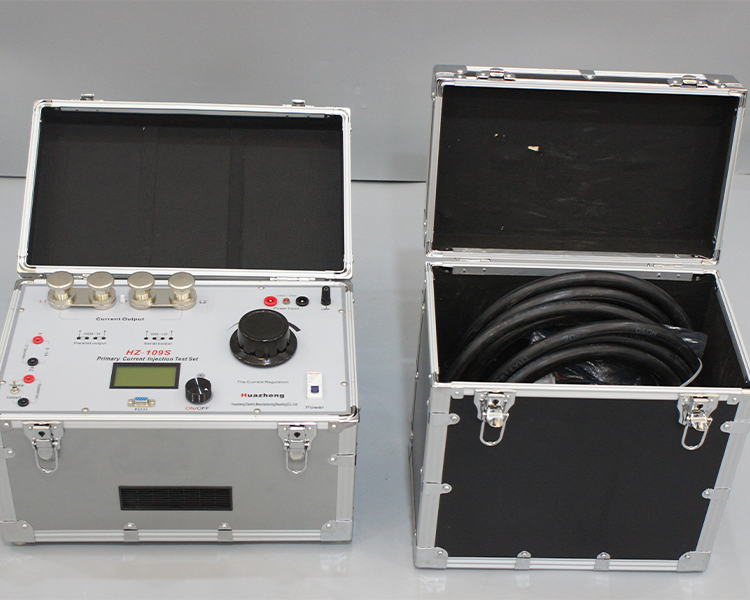
The traditional methods for testing the transformation ratio of current transformers (CT) are the standard CT method or the dual ammeter method, which have complex wiring and require manual calculation of the transformation ratio. The HZ-109S has a built-in ratio measurement function, and the LCD screen can simultaneously display I1 (primary current), I2 (secondary current), and the calculated ratio without the need for additional conversion.
wiring method
Primary circuit: Connect the high current output line to the primary side of the CT to form a high current circuit. A current flows out from the high current output terminal of HZ-109S, passes through the primary side of CT, and then returns to the high current input terminal.
Secondary circuit: Connect the secondary side of the CT (usually 5A or 1A output) to the "Secondary Current Measurement Input Terminal" (two terminals labeled I2) on the HZ-109S panel. Attention: The CT secondary side must be connected to a load (the measurement input circuit of the instrument is the load), and must not be open circuited - the CT secondary open circuit will generate dangerous high voltage, which may break through the CT insulation and endanger personal safety.
Variable ratio range setting
HZ-109S supports two secondary rated current ranges:
5A range (displaying "0.000/5"): suitable for CT with a secondary rated current of 5A
1A range (displaying "0.000/1"): suitable for CT with a secondary rated current of 1A
Move the cursor to "5" (or "1") in the zoom display and press the rotating mouse to switch. If the rated secondary current of the CT being tested is 5A, select the 5A range; If it is 1A and the 1A range is selected, selecting the wrong variable ratio will result in a difference of 5 times in the displayed value.
test process
Raise the current to an appropriate value (usually 50% to 100% of the rated current to avoid excessive magnetic saturation), and after stabilization, the screen will display:
I1: Actual measured current value (unit: A)
I2: Measured secondary current value (unit A, resolution 0.001A)
Transformation ratio: I1/I2 measured and calculated values
Compare the displayed transformation ratio with the nameplate transformation ratio, and if the deviation is within the allowable range (usually ≤ 0.5%), it is considered qualified.
CT with multiple taps
There are multiple variable ratio connectors for CT, and each connector needs to be measured separately. When switching connectors, first reduce the current to zero, stop the output, and then switch connectors to measure the current again.