



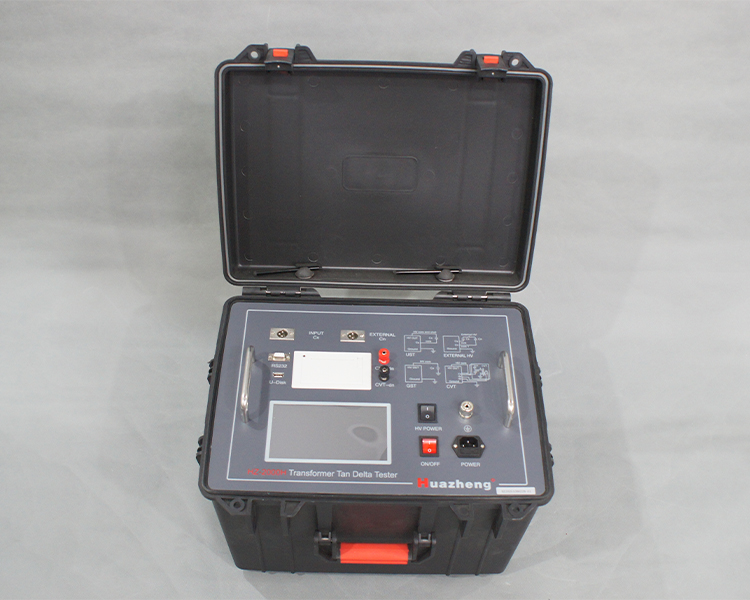
After measuring the dielectric loss, negative values of tan δ were displayed on the screen, and many engineers' first reaction was that the instrument was faulty. In fact, in most cases, negative dielectric loss is not a problem with the instrument, but rather caused by improper measurement method selection or on-site interference. The HZ-2000H manual specifically lists several scenarios that can cause negative dielectric loss.
Reason 1: Directly measuring the coupling capacitance of the CVT lower section using conventional methods
This is the most common source of negative dielectric loss. The two ends of the lower section C2 of the CVT - the upper end is connected to C1 (and then to the high-voltage bus), and the lower end is grounded - if measured directly with a conventional reverse wire, the T-shaped network formed by C1 and the bus will introduce an additional capacitive current to C2, which is ahead of the actual measured current in phase, resulting in a negative comprehensive tan δ.
Solution: Use CVT self-excited method (HZ-2000H specifically provides this function), inject measurement voltage from the auxiliary winding, eliminate external capacitor network interference, and obtain the true C2 dielectric loss value.
Reason 2: Moisture during the measurement of electromagnetic PT using the end shield method
When using the end shielding method (end pressurization method) to measure electromagnetic PT, if the lower three skirt porcelain bushing and the terminal block of the PT experience surface leakage due to moisture, an additional resistive current will be introduced into the equivalent circuit. This current, when superimposed under certain phase conditions, will cause the measured tan δ to show a negative value.
Solution: Use a hot air gun or hair dryer to dry the lower three skirt porcelain bushing and terminal block (remove surface moisture), and re measure. Usually, the negative dielectric loss will disappear and return to normal positive values. Conventional methods (without end shielding) or end pressurization methods can also be used for measurement.
Reason 3: Excessive air humidity
In high humidity environments, the water film on the surface of the test sample forms a leakage path, introducing additional dielectric loss current, causing fluctuations or even negative values in the measurement results. Solution: Find a dry environment or install shielding rings at key insulation positions of the test sample to reduce the impact of surface leakage on measurement.
Reason 4: Hidden open circuit in the measuring line or short circuit between the core wire and the shield
After long-term use of the measuring line, poor contact of the plug, breakage of the core wire at the bend, and insulation failure between the core wire and the shield can all introduce false signals, leading to abnormal data (including negative dielectric loss). Solution: Use a multimeter to check the continuity and insulation condition of the measuring wire, and replace the measuring wire if any problems are found.
Instrument self checking method
When suspecting that there is a problem with the instrument itself, unplug all test wires first and test the boost voltage in the air; Measure standard capacitors or capacitors with known capacity and dielectric loss using positive and negative wiring, and if the results are correct, the instrument fault can be ruled out.