

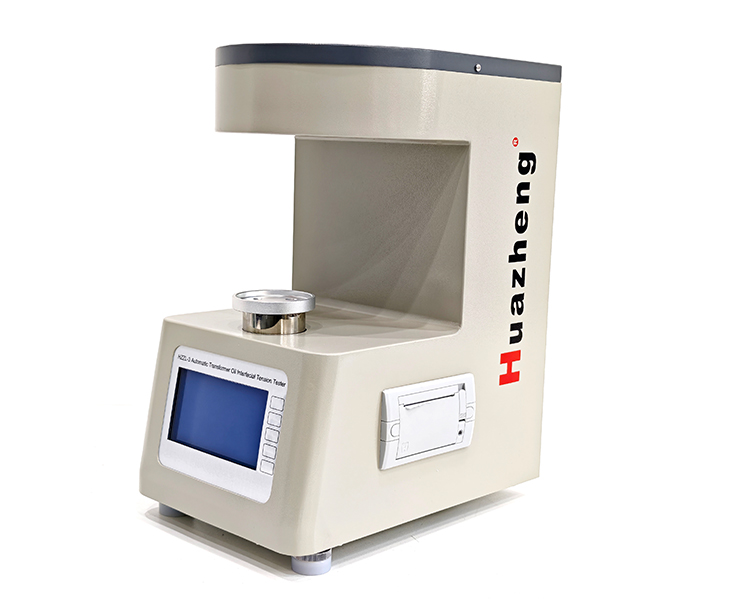
HZZL-3 can measure both surface tension (liquid gas interface) and interfacial tension (liquid-liquid interface). The two use the same platinum ring process, but there is a key difference in parameter settings, and mixing them up can lead to systematic deviations in the calculation results.
Core difference: filling in the density of light liquid
There are two density parameters in the Zuidema Waters correction formula: heavy liquid density (P ₀) and light liquid density (P ₁). The meaning of the formula is that when the platinum ring pulls up the liquid film, the liquid film is affected by its own gravity, which depends on the density difference between the liquid film material (heavy liquid) and the surrounding medium (light liquid).
When measuring surface tension (such as measuring the surface tension of water):
Heavy liquid density=density of water (approximately 0.997g/mL, 25 ℃)
Light liquid density=density of air (approximately 0.00129g/mL) - Above the platinum ring is air, so the density of the upper medium is filled with air
When measuring interfacial tension (such as measuring the interfacial tension between transformer oil and water):
Heavy liquid density=density of water (lower layer liquid)
Light liquid density=density of insulating oil (upper layer liquid, about 0.88-0.90g/mL) - at this point, oil is above the platinum ring instead of air
This difference has a significant impact on the calculation of the correction factor F. If the air density (about 0.001) is still filled when measuring the interfacial tension, which is far from the actual density of the upper liquid layer (about 0.89), the correction factor calculation will be severely biased, and the final result will be much smaller than the true value.
The instruction manual specifically notes this note in the parameter description, indicating that it is the most prone to errors in practical operation.
Operation of test bench height
The operation process of the two tests also has slight differences:
Measure surface tension: After placing the sample cup and immersing the platinum ring 5mm below the liquid surface, wait for 30 seconds to start measuring directly (30 seconds for the liquid gas interface to stabilize).
Measure interfacial tension: After immersing the platinum ring in the lower liquid (water), the instrument will prompt "Please add upper liquid" - slowly add insulating oil at this time, let the oil cover the water surface, and the platinum ring is surrounded at the interface between the two phases. Then press "continue" and wait for 30 seconds for the interface to stabilize before starting to descend for measurement. When refueling, be gentle and do not stir the lower layer of liquid, otherwise the oil-water interface will be unstable and the reproducibility of measurement results will be poor.