



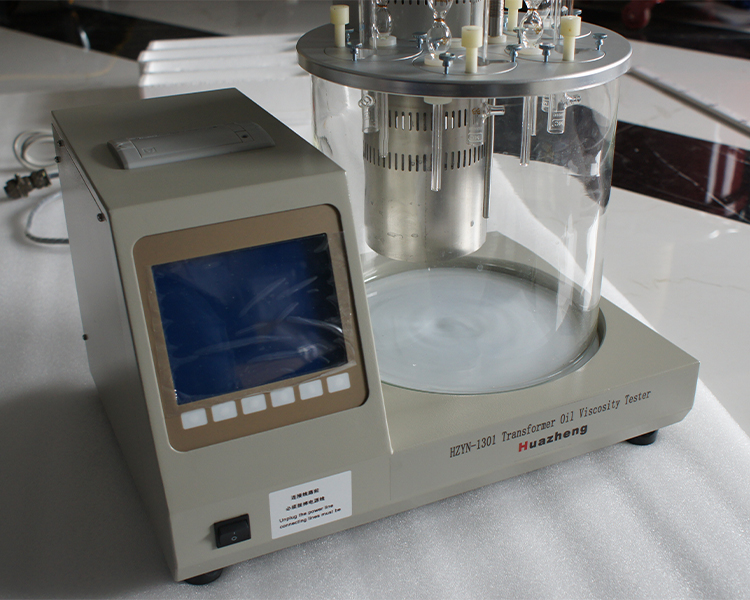
When conducting viscosity measurements, many people mistakenly believe that the average of four experiments is simply calculated once the results are obtained. In fact, the GB/T 265 national standard imposes strict qualification checks on the four sets of data. The HZYN-1301 instrument automatically applies this logic, marking unqualified data with a horizontal line. Only by understanding this logic can one correctly interpret the calculation results from the instrument.
Calculation requirements of national standards
According to GB/T 265-88, the flow time data collected for four times must meet certain reproducibility requirements before the set of data can be considered valid. The specific judgment method is as follows:
In the four sets of data, the instrument calculates the deviation of each set of data from the average value according to the standard. Data that exceeds the allowable reproducibility is marked as "unqualified" (with a horizontal line drawn below the data on the screen).
If two groups fail, the entire group is invalid
The HZYN-1301 instruction manual specifies that if two or more groups among four flow times are judged as unqualified, the entire set of experiments is considered unqualified, and the kinematic viscosity result cannot be calculated. A new set of four experiments is required.
The handling method for the instrument is as follows: if the measurement result is unqualified, it will not be displayed and the operator will be prompted to conduct a retest. This is not due to an instrument malfunction, but rather a strict adherence to national standards - unqualified data cannot be hastily reported as viscosity values.
Use of the "Retest" function
If there is one obvious anomaly in the four sets of data (such as pressing the wrong start/stop button due to operational error), the "Retest" function can be used: discard the first set of data, perform the test again, and use the newly obtained set of data to form a new data group for recalculation. This avoids having to redo all four tests, saving time.
However, it should be noted that if there are more than two anomalies in four sets of data, retesting once will not solve the problem; the entire process must be redone.
Calculation method for less than 3 times
The instruction manual states that if the number of experiments is set to less than 3, the instrument will directly calculate the average value without conducting the national standard compliance check. This setting is suitable for teaching demonstrations or preliminary trials. For formal testing, it is necessary to conduct 4 experiments and pass the national standard criteria.
Why 4 times instead of more
Four experiments strike a balance between accuracy and efficiency in accordance with the national standard: four sets of data are sufficient to identify significant operational errors, while not consuming excessive experimental time and samples. For high-viscosity oils (where each flow time may last for several minutes), four experiments themselves require a considerable amount of time, and increasing the number of experiments would significantly reduce work efficiency.