



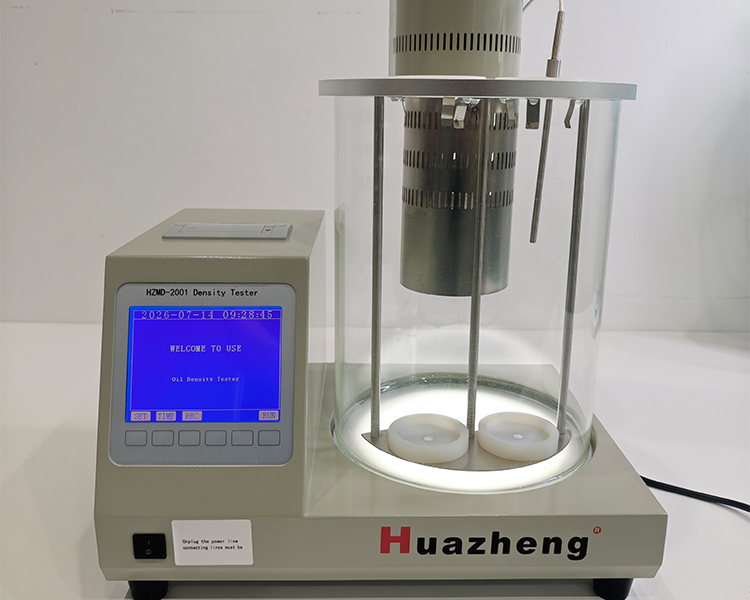
The HZMD-2001 utilizes PID self-tuning temperature control technology, achieving a temperature control accuracy of ≤±0.1℃. This specification holds greater significance for density measurement than for other physical tests, as the sensitivity of petroleum density to temperature is extremely high.
Quantification of the impact of temperature on density
Taking the common transformer insulating oil as an example, its density temperature coefficient is approximately 0.00065 g/cm³/℃, meaning that for every 1℃ change in temperature, the density changes by approximately 0.00065 g/cm³. While this may seem small, it has significant implications for oil trade measurement:
When measuring 10,000 liters (10 tons) of insulating oil, a temperature error of 1℃ leads to a mass measurement error of approximately 6.5 kg, which translates to a monetary deviation ranging from tens to hundreds of yuan. For oil depots that measure dozens of batches of oil products daily, the cumulative error is considerable.
If the temperature control accuracy is only ±0.5℃ (worse than the ±0.1℃ of the HZMD-2001), for the same metering application, the error per batch may reach ±3.25 kg, which is five times greater than the error with precise temperature control.
The working principle of PID
The ordinary switch temperature control (bang-bang control) only has two states: "heating" and "stopping". The temperature repeatedly oscillates around the set value, resulting in poor accuracy (above ±0.5℃).
PID (Proportional-Integral-Derivative) temperature control dynamically adjusts the heating power based on the current temperature deviation, the historical accumulation of deviations, and the rate of change of deviations:
When the temperature approaches the set value, the heating power is automatically reduced to avoid overshoot
When the temperature is slightly lower than the set value, maintain low-power heating to compensate for heat loss due to radiation
Quick adjustment in response to external temperature disturbances (such as heat dissipation through opening the cover)
The auto-tuning function further simplifies the configuration of PID parameters: after the instrument is used for the first time or after changing the bath solution, it automatically undergoes a learning process to determine the optimal PID parameters based on the thermal response characteristics of the heating system, eliminating the need for manual debugging. This is a great convenience for operators who are not familiar with the principles of PID.
Fine-tuning temperature function
Even with high temperature control accuracy achieved by PID, there may be slight deviations between the installation location and reading accuracy of the sensor and the actual sample temperature. The HZMD-2001 provides a fine temperature adjustment function of ±3.0℃. After measuring the actual sample temperature with a calibrated reference thermometer and comparing it with the temperature displayed on the instrument, this deviation can be compensated through fine adjustment to further improve measurement accuracy.