



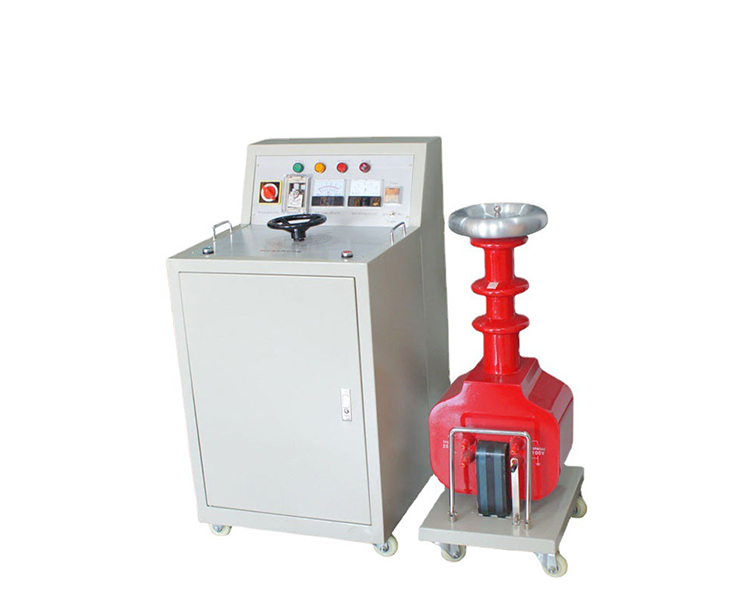
When conducting power frequency withstand voltage tests, there is occasionally a phenomenon that catches people off guard: the voltage regulator only rotates a little bit, but the voltmeter rises very high, and even the test object has exceeded the voltage breakdown before it can react. This is the resonance phenomenon. Special reminder in the manual: During the power frequency withstand voltage test, please pay attention to checking whether the equipment capacity is sufficient and whether resonance can be avoided.
Conditions for resonance generation
When the leakage reactance (inductive) of a transformer and the capacitance (capacitive) of the test object are equal at a certain frequency, series resonance occurs. During resonance, the circuit current can be many times higher than the normal operating current, and the voltage output to the test object may also far exceed the rated output voltage of the transformer - this "overvoltage" is caused by resonance and not set by the regulator, which is an unexpected and dangerous overvoltage.
In which situations does resonance usually occur
The test sample has a large capacitance (such as longer cables, power capacitors, and large transformer windings), and the risk is highest when it approaches resonance conditions with the leakage reactance of the test transformer. At a power frequency of 50Hz, the resonance condition depends on the product of the capacitance of the tested object and the leakage inductance of the transformer, and needs to be calculated and verified before the test.
How to avoid
Verification method: Calculate the leakage inductance L (converted from impedance voltage) of the test transformer and the capacitance C of the test sample, and check whether the resonant frequency of LC is within the range of 45-55Hz. If it is close to the power frequency, damping resistors should be connected in series in the circuit to suppress resonance, or frequency modulation resonance devices should be used instead of power frequency transformers.
Once it is found on site that the voltage rises sharply and the current increases abnormally during the voltage regulation process, the high voltage should be immediately reset and cut off. The voltage cannot be further increased, and resonance should be investigated before retesting.