



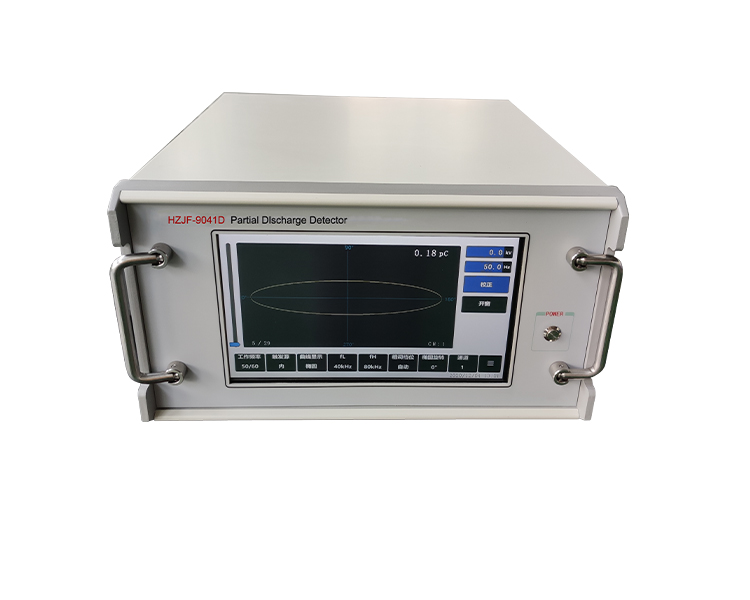
The HZJF-9041D amplifier offers three low-frequency options (fL: 10/20/40kHz) and three high-frequency options (fH: 80/200/300kHz), which are combined to form nine frequency bands. Each band has a different passband width and interference suppression ability. Improper selection can result in the true discharge signal being filtered or interference signals entering the measurement results.
The trade-off between wideband and narrowband
A wide frequency band (such as 10kHz to 300kHz) can receive discharge pulses with more frequency components, providing a more complete response to a single small discharge. However, it is also open to interference in a wider frequency range, resulting in higher background noise.
Narrow frequency bands (such as 40kHz to 80kHz) limit the passband to the 40kHz range, and interference must fall precisely in this frequency band to enter, significantly improving anti-interference ability, but the sensitivity to discharge pulses is relatively low.
Common frequency band selection reference
FL=40kHz, fH=80kHz (40-80kHz): The narrowest frequency band with the strongest anti-interference ability, suitable for testing environments with severe on-site interference. Many detection frequency bands recommended by IEC 60270 are also within this range, which has good applicability for partial discharge detection of transformers and other equipment.
FL=10kHz, fH=200kHz (10-200kHz): Wide bandwidth, high sensitivity, suitable for clean laboratory environments or low interference test sites, suitable for detecting weak discharge signals.
FL=20kHz, fH=300kHz (20-300kHz): The widest frequency band used for studying discharge characteristics across all frequency bands or for comparative analysis of multiple frequency bands.
In practical operation, it is recommended to first use a wide frequency band to find the discharge signal, then gradually narrow the frequency band, observe which frequency band the actual discharge signal is strongest and the interference signal attenuates the most, and finally select the optimal frequency band for formal measurement. HZJF-9041D supports switching frequency bands without interrupting testing, making it convenient for flexible on-site debugging.